
When a customer pays an advance remotely and the balance at pickup, one sale becomes two payment events. For an Armenian business, the choice of payment link, counter QR and online wallet acceptance affects how staff identify the remaining balance and handle a cancellation. Comparing payment providers in Armenia should start with that complete order, including the records needed after each payment.
ArcaLink, ArcaQR and wallet checkout illustrate these different starting points. The practical question is which arrangement fits your sales process, company and settlement requirements. A familiar payment name alone cannot answer it.
Payment links can fit orders agreed outside a website
Arca's services page describes ArcaLink as a mobile application for businesses to generate individual payment links without building a website. Access starts through the Armenian commercial bank servicing the business's corporate account. The merchant sends the generated link to the customer and sees the payment become confirmed in the app after payment.
For a business taking orders through calls or messages, that is a relevant option to investigate. Ask the bank which business activities and customer payment instruments it supports, how the amount and order reference are recorded, and whether links expire or can be cancelled. Confirm who can create links and how another employee checks an order's payment status. The public description does not establish those detailed controls or your eligibility.
A counter payment and wallet checkout need their own scope
Arca describes ArcaQR as payment by scanning a QR code, directly from a bank account, through participating institutions. Its QR acceptance scope should be checked separately from ArcaLink or card acquiring. Ask which customer apps are supported in the proposed setup and how staff receive confirmation at the point of sale.
Telcell Business makes another useful distinction: it offers offline QR acceptance and online payments through Telcell Wallet, with online payment history available in its business app. Those are separate application choices on its partnership page. A statement that a provider supports a wallet therefore needs a follow-up: for an in-person sale, an online checkout, or both?
These are public examples of local acceptance channels, not a claim that every shortlisted PSP or PayStar offers each one. Request a demonstration of the channel you intend to use, including an unsuccessful payment and the evidence available to your support team.

Follow one order across two sales moments
Consider a hypothetical Yerevan workshop selling a custom item for AMD 48,000. It requests AMD 12,000 when the order is agreed remotely, leaving AMD 36,000 due on collection. The business is evaluating a payment link for the advance and a QR payment at pickup. This is an example workflow to qualify, not a claim that a particular provider has approved it.
The order record must show both payments and the remaining balance. Staff should check confirmation through the provider's merchant tools before treating either amount as paid. Sending a link or displaying a QR code does not settle the order.
If the customer cancels before production, the workshop also needs an agreed way to return the AMD 12,000 advance under its cancellation policy. Ask whether a refund can reference that original payment, who approves it and what confirms completion. For a cancellation after both payments, establish how two returns would be tracked without refunding the same amount twice.
Evaluate how payment history can be exported or connected to your order records. A convenient customer experience can still leave manual reconciliation work; estimate that workload before choosing the arrangement.

Qualify the company and the currency before implementation
An Armenian payment method is not automatic access for every company. For a concrete example, Ameriabank's Internet Acquiring Terms and Tariffs, edition 9, effective 27 April 2026, define a resident merchant connected to a bank customer relationship. They also specify AMD price display and conditions for transactions in Armenia when a website supports foreign currency.
Those are requirements of that particular acquiring service, not a universal eligibility decision for every Armenian payment product. Ask each proposed provider to confirm the contracting entity, business activity, customer geography and permitted transaction currencies. Separately record the currency credited to your business account, any conversion and the applicable settlement timetable. A USD association in a database does not establish a USD checkout or cross-border settlement arrangement.
AMD payouts are a separate purchasing decision
Collection settlement moves sale proceeds to the merchant under the provider agreement. A supplier payment or other business payout has a different recipient and purpose. A consumer transfer feature or QR acceptance description is insufficient evidence for an approved business payout service.
Give payout candidates the recipient types, destinations, purpose, typical amounts and expected volume. Request the funding requirements, beneficiary checks, fees, limits and treatment of rejected transfers. Ask how payment, refund and payout records will reconcile with the actual account movement. Obtain the current terms for the specific operation rather than treating a collection demonstration as proof of payout capability.
Turn the Armenia requirement into a focused shortlist
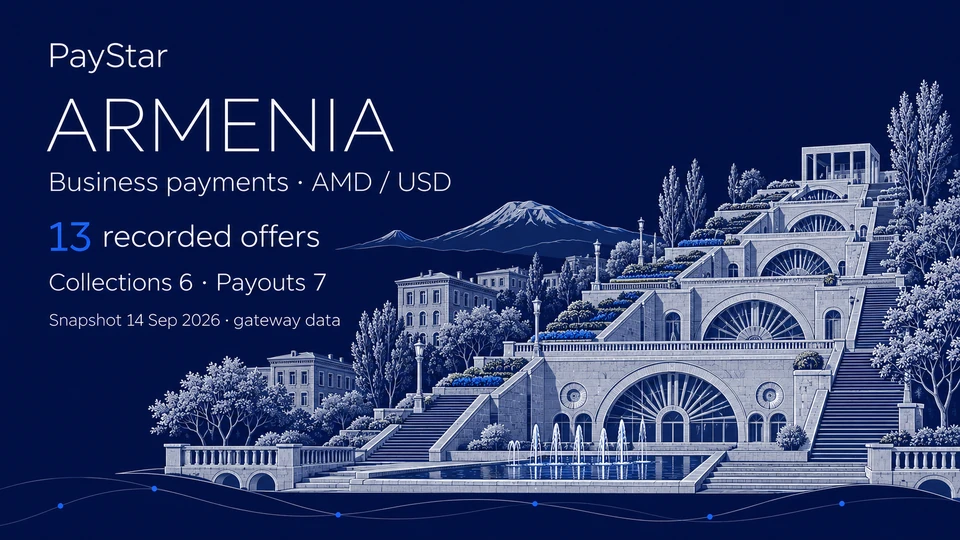
PayStar's 14 September 2026 snapshot contains 13 unique recorded payment offers associated only with Armenia: six classified as collections (Deposit) and seven as payouts (Withdrawal). Eleven offers have an AMD association and two have a USD association. These are offer records, not independent PSPs, live integrations or approved routes. Separately linked countries, currencies and methods do not prove every combination; current availability and merchant eligibility require confirmation.
Want information about these payment options for free? Just write to us. Contact Anastasia through PayStar Discovery with your sales channels, registration country, business activity and collection/payout requirements. PayStar helps structure the shortlist and qualification questions. Free information does not include integration, processing or all subsequent Discovery services. The merchant selects and contracts directly with the PSP, which handles approval, processing and settlement.

PayStar’s role
PayStar provides information and technical services. PayStar is not a bank or PSP, does not arrange payment acceptance or settlement in its own name, does not receive or hold customer or merchant funds, and does not settle those funds. Payment services are provided by the selected provider under a direct agreement with the merchant. PayStar’s API, routing and monitoring operate within the agreed technical role.