
A payment option for Benin needs to do more than accept a wallet payment. Your team must match the receipt to an order, identify the right payout beneficiary and know when collected XOF can fund the next batch. A familiar mobile-money name does not answer those three questions.
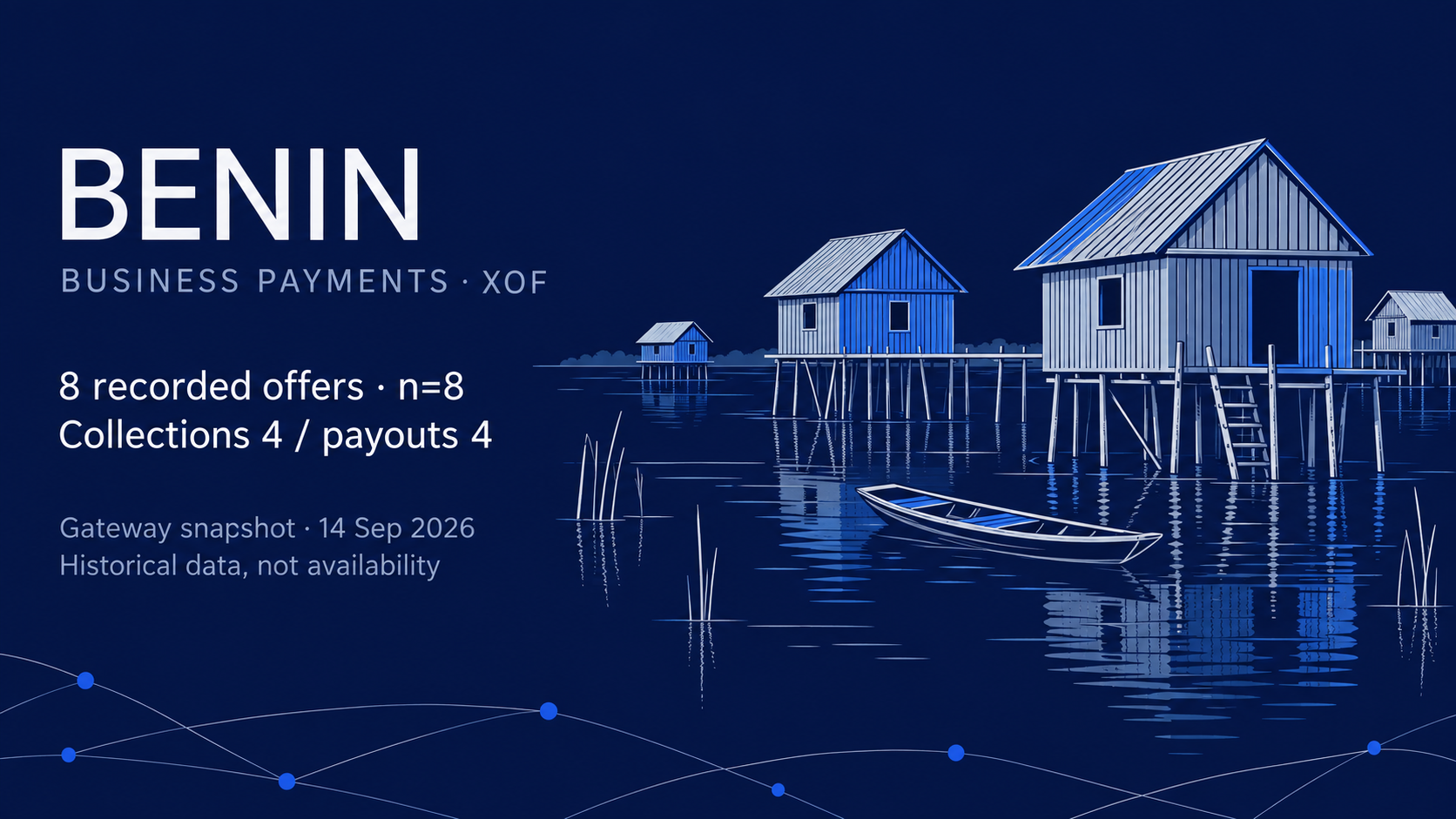
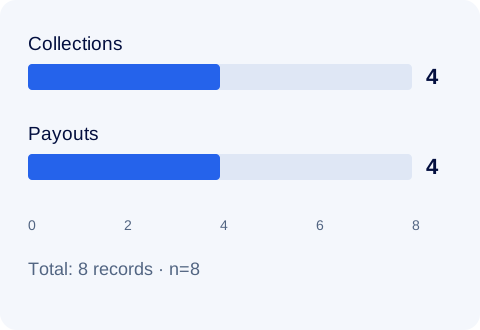
We reviewed 8 unique offer records linked only to Benin: 4 collection records and 4 payout records, all with an XOF currency link. These are historical gateway-supplied records from 14 September 2026, not eight payment methods, independent providers or confirmed live connections. Conditions may change weekly or more often; PayStar has not independently verified the gateways’ commercial statements.
Benin has a practical integration detail worth checking early: its telephone-number migration also affects mobile-money identifiers. That makes the beneficiary field, the payment reference and a clear response to an uncertain transaction part of the commercial comparison—not merely a task left for the developer.
1. Eight records, several different payment jobs
The catalogue’s even 4/4 split describes the recorded directions. It does not show how much volume each direction processes, which wallet is active for a particular business, or whether collections can automatically fund payouts. International multi-country records are outside this country-only count. Country, currency and method links were stored independently, so they do not prove every possible local route.
Local products illustrate why the job needs to be specific. MTN Benin’s MoMoPay page describes merchant-code and QR payment journeys. Its business collection page separately describes an online collection option. These establish public product context, not their availability through a provider in our sample or through PayStar.
Celtiis Cash also describes goods-and-services payments and QR transactions. A consumer app feature or public consumer tariff is not a merchant acquiring agreement. Ask which business account, payment operation and settlement arrangement the proposed integration actually covers.
For a shop, the first acceptance test is simple: can an authorised payment be linked to the correct order without a staff member comparing screenshots? Request an example of the final status, merchant reference, provider transaction identifier and reconciliation entry. Treat this as a proposed test, not as a capability we have verified for every product.
2. Compare the complete cost at your payment size
Each direction has only four Benin-only records. We do not publish their individual nonpublic terms or real fee averages and ranges from this small group. There is no defensible “average market price” in this article. Obtain a fresh written quote for your business and transaction sizes.
The following numbers are fictional tariffs for arithmetic only, not quotations or a market benchmark. Suppose model A charges 2% per successful payment, and model B charges 1.5% plus XOF 50. On an XOF 2,000 payment, A costs XOF 40 and B costs XOF 80. At XOF 10,000, both cost XOF 200. At XOF 20,000, A costs XOF 400 and B costs XOF 350.
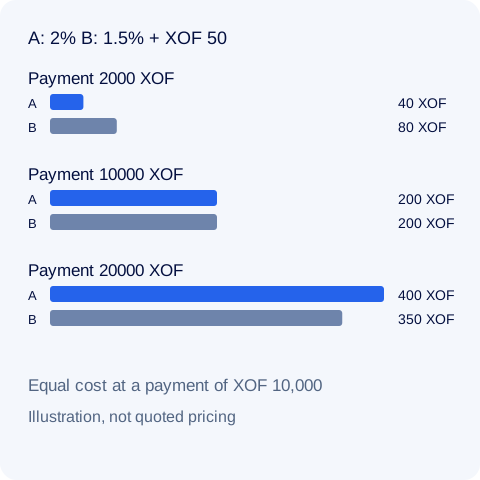
The illustrative break-even payment is XOF 10,000: XOF 50 divided by the 0.5 percentage-point difference. A smaller headline percentage is therefore not enough to choose the cheaper model for a small basket. Neither model includes taxes, refund charges, minimum monthly fees, FX, bank transfers or integration costs.
Run the calculation against your own mix of small and large orders. Confirm whether the fee is assessed on an attempted, successful or settled transaction; whether a failed payout is charged; and what happens to the fee after a reversal. Keep payer costs, merchant collection costs and beneficiary cash-withdrawal costs separate.
3. Fund payouts from released money
A customer’s successful payment and a usable business balance are separate events. Ask for the account in which collected XOF appears, the release conditions, the payout funding mechanism and a reconciliation file showing each deduction. A written T+0 or similar label would be a contractual description, not evidence of measured speed.
Here is an explicitly fictional funding example. A business records XOF 500,000 in collections. It deducts XOF 10,000 in fees, sets aside an assumed XOF 25,000 reserve, and has XOF 100,000 not yet released. Its usable amount is XOF 365,000. If a payout batch requires XOF 400,000, the funding gap is XOF 35,000.
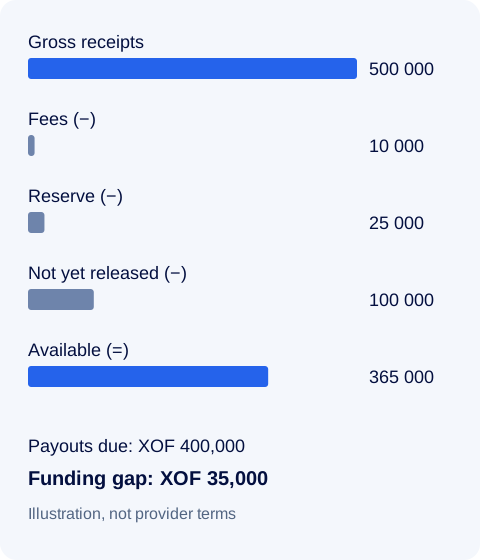
The reserve and release amount are assumptions, not a Benin requirement or a provider’s actual conditions. The example also assumes the remaining funds can be used for the stated obligation. Confirm that point explicitly: balances at different providers or in different accounts may not be interchangeable.
Compare the timing of your payroll, supplier or marketplace obligations with the latest usable balance. Ask how weekends, bank transfers, payout prefunding and any contractually agreed holds affect that balance. We have no comparable observed settlement-time data for this sample and make no speed claim.
4. The Benin beneficiary field deserves its own check
ARCEP Benin states that national numbers moved from eight to ten digits on 30 November 2024 by adding 01. It explicitly includes mobile-money use. The international form is +229, then 01, then the former eight-digit number. This is a numbering rule, not proof that a wallet account exists or belongs to the intended person.
For implementation, agree the exact field format with the selected provider before importing a beneficiary list. Preserve the number as text so a spreadsheet cannot discard the leading zero. Detect an already-normalised value before applying any migration, and retain the original input for investigation under your data-retention controls. These are our operational recommendations, not additional ARCEP rules.
If a historical customer record and a newly entered number differ, resolve identity and the intended recipient through your approved verification process. Do not automatically replace a stored payout destination based only on a plausible telephone format. Also ask what the provider can actually confirm about the account before money is sent.
5. A payout batch needs an outcome per beneficiary
MTN Benin’s separate bulk-payment product describes uploading a payment file, identifying the payment purpose and accessing transaction reports. This is evidence of a local business payout scenario, not proof that any particular API or gateway supports the same workflow.
Before choosing a payout integration, request a sample batch report and answers to three practical questions. Can accepted, pending, rejected and reversed items be distinguished? Which reference prevents an accidental duplicate? How do you confirm the final result when a request times out? These are evaluation criteria; the article does not assert that the provider implements them in a particular way.
Test an intentionally invalid beneficiary, an insufficient-balance case and a delayed confirmation in an approved test environment. For an uncertain live result, investigate the original payment before a fresh retry. A file being accepted is not the same as every beneficiary being paid.
The catalogue contains no comparable measured checkout-conversion or payout-success series. We therefore give no average success rate and do not infer one from the number of offers. Record your own denominator, time window, final-state rules and exclusions before comparing outcomes across routes.
6. Check the contracting entity and the permitted operation
BCEAO’s electronic-money register, dated 28 February 2026 on the consulted page, distinguishes electronic-money institutions from bank partnerships in Benin. A product brand is not enough to identify who issues the money and who signs the business agreement. BCEAO’s explanation of issuance also distinguishes banks’ notification from the authorisation required for other structures.
Use current official records and the proposed contract to establish the legal entity, permitted service, business eligibility and allocation of responsibilities. This article does not certify a provider or give legal approval to a business. Domestic wallet acceptance does not by itself establish permission for cross-border merchant settlement, foreign-currency conversion or every business sector.
MTN’s business onboarding page requests company-registration and IFU information alongside address, representative and banking evidence. That is one operator’s published onboarding context; it is not a universal checklist or a promise that those documents secure approval. Request the complete applicable file and specialist review for your own product and settlement model.
7. PayStar’s role
PayStar provides information and agreed technical services. PayStar is not a bank or payment service provider and does not organise payment acceptance or settlement in its own name. It does not receive or hold customer or business funds, or settle those funds.
The business chooses its payment provider and signs a direct agreement with that provider, which supplies the payment services and handles processing and settlement. PayStar Discovery can help structure the comparison and its requirements. PayStar Direct Connect and PayStar Core can support agreed API, routing and operational-control functions within PayStar’s technical role. Information about a product, a qualified option and an active route are different states; none guarantees eligibility, availability or results.
8. Get details on payment gateways in Benin
Ask Anastasia for information about collection methods and XOF payouts, complete fees and limits, settlement accounts and release timing, and the product and document requirements. Information in this scope is free; processing, integration and other services are not included in that statement. Availability and business eligibility must be confirmed separately.
Bring one typical payment size, your payout deadline and the beneficiary format you need. Those inputs make it easier to compare total cost and operational fit. Contact Anastasia on Telegram or by email.