
A German checkout can accept a payment quickly and still leave the business with questions: which payment rail was used, how much of the sale remains after fees, and when can that money fund the next order? A low headline percentage answers only one part of the decision.
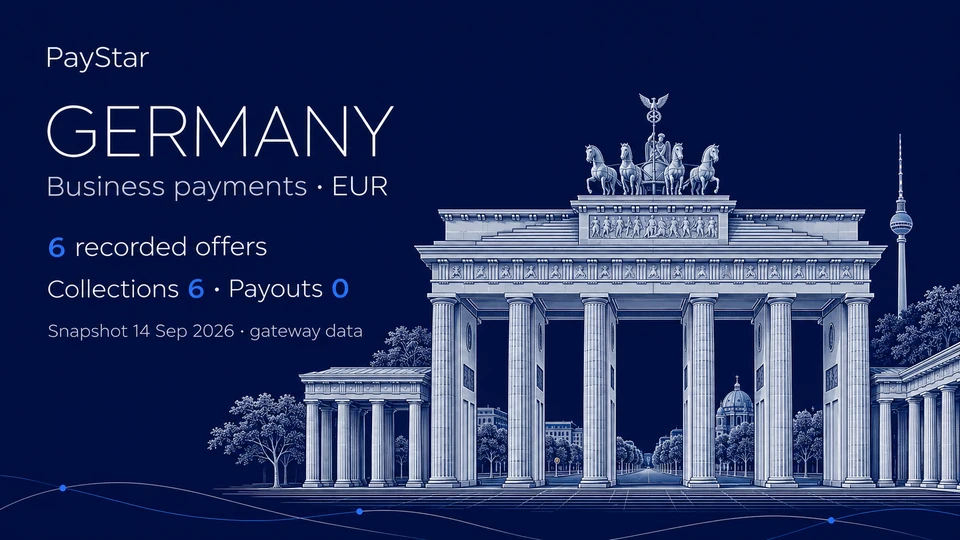
We examined 6 unique offers linked only to Germany, all recorded for EUR collections, in the gateway-supplied snapshot of 14 September 2026. The useful next step is to compare a merchant's payment channel, ticket size and cash-flow needs against explicit provider terms. These records are a research starting point, not 6 independent PSPs or verified live connections.
1. Six collection offers, with a clear boundary
The wider Germany-linked inventory contains 198 unique offers: 6 linked only to Germany and 192 listing multiple countries. We use the narrower cohort for this article. Country, currency and payment-method links were supplied independently, so a country association does not establish every possible combination of methods and currencies.

All 6 country-only records are collections in EUR. There are 0 payout records in that cohort. This does not mean German business payouts are unavailable; it means this dataset cannot substantiate a local payout comparison. A EUR disbursement requirement needs its own provider qualification.
We withhold recorded individual fee and settlement terms because this is a small cohort. There is no defensible market-average tariff or measured approval-rate benchmark here. The examples below are deliberately fictional and show what to calculate once comparable written quotes arrive.
2. Germany is a channel question before it is a method list
For girocard, distinguish physical checkout from a merchant app. The scheme's 24 June 2026 announcement describes an in-app pilot framework; it does not establish universal online acceptance. Confirm the precise customer journey, issuer participation and provider implementation for the intended channel. girocard: in-app payments.
For SEPA Direct Debit, consent and refund handling matter alongside collection cost. EPC describes mandates for both Core and B2B. Under Core, a payer can request a refund within 8 weeks without justification; an unauthorised debit can trigger a request up to 13 months. B2B is for business payers and has different authorised-payment refund rules. EPC: SEPA Direct Debit.
For SEPA instant credit transfers, Bundesbank describes round-the-clock transfers normally completed within 10 seconds and explains recipient-name/IBAN verification. That describes the transfer service. It does not establish a provider's checkout, order matching or merchant settlement promise. Bundesbank: instant payments and verification of payee.
These are locally relevant mechanisms to discuss, not methods proven available through every offer counted above.
3. Why the lower percentage can cost more
Fictional illustration — not a quoted German tariff. Compare quote A at 0.9% + EUR 0.20 per successful payment with quote B at 1.2% and no fixed component. Other charges are deliberately excluded.
At a EUR 20 ticket, A costs EUR 0.38 and B EUR 0.24. At EUR 80, the figures are EUR 0.92 and EUR 0.96. At EUR 200, they become EUR 2.00 and EUR 2.40. The two illustrative price lines cross at about EUR 66.67, from 0.20 ÷ (0.012 − 0.009). This is a comparison of invented fee formulas, not a recommendation for either quote.

Use your actual ticket distribution rather than one average ticket. Ask whether declined attempts, refunds, disputes, minimum monthly charges, tax or currency conversion add cost. For subscriptions, add collection failures and recovery work. Do not compare a terminal fee with an online checkout fee unless both cover the same service and risk allocation.
The working calculation is: total agreed transaction charges plus other applicable costs, divided by settled sales volume. Keep the numerator and denominator from the same period and distinguish fees from funds temporarily held.
4. Arrival, settlement and usable money are separate milestones
Ask which account receives the customer's money, which event changes the order to paid, and when the merchant may transfer the balance onward. An instant bank transfer to a receiving account is not proof that a PSP releases the merchant balance instantly.
Fictional cash-flow illustration: assume a steady EUR 10,000 of collections per operating day and a simple release lag of either 1 or 3 operating days. With no fees, reserves, refunds or other movements, the approximate amount awaiting release is EUR 10,000 versus EUR 30,000. The difference is EUR 20,000. This simplified model is not a measured German settlement schedule.

A real forecast must specify business versus calendar days, cut-off times, weekends, minimum settlement amounts, reserves and withdrawal fees. For direct debit, retain a separate view of potential refund exposure after cash arrives. Money credited and money no longer exposed to reversals are different accounting questions.
5. Test the evidence that closes the order
Before launch, agree how each payment maps to an order and how exceptions return to your operations team. A screenshot or customer-facing success screen should not be the sole fulfilment signal. Ask for the provider's authoritative status, transaction reference, amount, currency and reconciliation record.
Run agreed tests for duplicate notifications, a delayed confirmation, partial refunds and an unmatched bank payment. For direct debit, include a returned collection and the reason-code workflow. This is a proposed acceptance checklist, not a claim that we tested the 6 offers.
The snapshot contains no comparable measured conversion cohort. Do not infer acceptance rates from method names, commercial descriptions or the speed of a payment rail.
6. Qualify the entity and the operating arrangement
Identify the exact legal entity supplying each regulated payment service, the relevant authorisation and the service/country scope. The EBA register provides information about authorised or registered payment and e-money institutions in the EU/EEA and links national registers; an entry is not a merchant approval. Confirm the contractual scope with the provider. EBA: payment institutions register.
For direct-debit collection, clarify who is the creditor and whose creditor identifier is used. Bundesbank states that it allocates German creditor identifiers to applicants with a principal residence or office in Germany; allocation itself is not permission to collect direct debits through a bank. Bundesbank: creditor identifier.
Request eligibility for your actual business model, customer geography, incorporation country and expected turnover. Record responsibilities for mandates, refunds, complaints and reconciliation in the direct PSP agreement. A general country guide cannot confirm the legality or availability of a particular merchant route.
7. PayStar's role
PayStar provides information and an agreed technical layer. It is not a bank or PSP and does not arrange acceptance or settlement in its own name. PayStar does not receive or hold customer or merchant funds and does not settle them.
The merchant selects the provider and signs a direct agreement with that PSP, which performs the payment services. PayStar Discovery helps structure the requirements and compare candidate terms. Where separately agreed, PayStar's API, routing and operational controls support the selected arrangement within the technical scope. Neither this article nor an integration guarantees provider approval, live availability or a commercial result.
8. Get details for your Germany payment brief
Ask Anastasia for free information about methods, fees and limits, settlement timing/currency, and product/document requirements. Availability and business eligibility need separate confirmation. Free information does not mean free integration, processing or every Discovery service.
A useful shortlist for Germany should answer a concrete question: can the proposed payment channel deliver the right evidence, total cost and usable EUR for this business?
9. Data and illustration notes
Commercial snapshot: 14 September 2026. Research checked: 6 October 2026. Counts deduplicate offer IDs; 6 Germany-only records are all EUR collections. The 192 multi-country records are not added to the local count. Offer records are not a PSP count, connection count or representative market sample. Gateway commercial statements were not independently verified; terms may change weekly or more often. Current eligibility must be checked again.
Private records, providers, contacts and individual terms are excluded. Fee and cash-flow illustrations are fictional. Cover artwork is an editorial AI illustration of a German architectural scene, not a documentary photograph or a map of coverage.