
When comparing payment providers in Ghana, start with a practical question: can your team identify which customer paid which business location, then follow that payment through refunds and settlement? A provider's support for bank accounts or mobile money is only the beginning. Your operating model also needs a reliable connection between the merchant, the till and the order.
Ghana's GhQR infrastructure makes this a useful place to start. It gives businesses a common merchant-payment interface across different customer funding sources. The choice of PSP should establish how that shared infrastructure becomes a collection service for your company.
GhQR: identify the merchant and the payment point
GhIPSS describes GhQR as supporting payments from bank, wallet and card accounts across participating institutions. An acquiring bank, mobile money operator or PSP signs up the merchant and supplies the QR code. Codes can be static or dynamic. Each payment point or till has a unique Terminal ID linked to the merchant or merchant ID; this also supports USSD payments from feature phones. GhIPSS: Ghana's Universal QR Code.
For a business with several locations, ask the acquiring institution how these identities appear in its reports and payment confirmations. Which identifier represents the legal merchant, which represents the till, and which identifies a particular sale? Request sample records before deciding that one QR setup meets your reconciliation needs.
Consider a hypothetical retailer with two tills. Two customers each pay GHS 180, one from a bank account and the other from a wallet. Total receipts are GHS 360, but an amount-only match cannot distinguish the orders. Ask the PSP to demonstrate how its transaction reference, payment-point identity and your order reference establish the correct match. This is an acceptance test to request, not a claim that every provider supplies those fields.
The GhQR customer FAQ describes scan-to-pay and USSD-based dial-to-pay, with notifications to both parties after a successful payment. It directs customers to their bank or wallet provider for limits and cases where an account was debited but the merchant did not receive payment. Test that exception path alongside a normal sale. GhIPSS: GhQR Customer FAQ.

Separate bank transfers from wallet interoperability
GhIPSS Instant Pay, or GIP, is described as a real-time interbank account-to-account credit transfer service. Its public description includes business and individual payments. GhIPSS: Instant Pay.
Mobile Money Interoperability, or MMI, separately describes transfers across wallet networks, bank-account-to-wallet transfers and wallet-to-bank-account transfers. These distinctions help you ask whether the proposed service collects from the customer's chosen source and pays the required destination. They do not establish that a particular PSP offers every direction through a business API. GhIPSS: Mobile Money Interoperability.
Ask each candidate for its supported source-and-destination combinations, separately for collections and payouts. Confirm the actual bank or wallet coverage, account requirements, transaction limits and available status evidence for your business.
Give four operations separate acceptance criteria
Use four rows in the PSP comparison, even if a sales proposal groups them under “payments”.
| Operation | Evidence to request |
|---|---|
| Customer collection | Approved merchant and till identities, a matched order, payment status and the account credited. |
| Refund | Link to the original collection, permitted destination, approval procedure, partial-refund support and final result. |
| Wallet disbursement | Eligible recipient wallets, funding source, recipient checks, limits and item-level results. |
| Merchant settlement | Agreed destination account, currency, deductions, timing and a reconciliation statement. |
In the two-till example, suppose one customer returns a GHS 60 item. Ask whether the provider supports a refund linked to that GHS 180 sale. If it proposes a separate wallet transfer, establish how the recipient is verified and how the transaction is tied back to the return. A successful outbound transfer alone does not document which purchase was refunded. This is a workflow question for the provider; the cited GhQR pages do not establish a universal refund procedure.
For business wallet disbursements, request a separate demonstration covering a successful payment, a rejected recipient and an unresolved result. Agree what evidence permits a retry so that an uncertain response does not create a duplicate payment.

Follow the money to the agreed settlement account
GhIPSS's third-party settlement service concerns obligations between participating financial institutions at the central bank. That infrastructure description does not establish a merchant's contractual settlement arrangement. GhIPSS: Third Party Settlement.
Ask where collected GHS becomes available, whether funds can finance disbursements, and how fees or reserves affect the usable balance. If your company requires conversion or an overseas settlement account, qualify that requirement explicitly. Domestic interoperability does not prove access to a cross-border arrangement. Obtain the proposed terms for your company and business activity rather than inferring them from a successful local payment.
A dated starting point for the shortlist
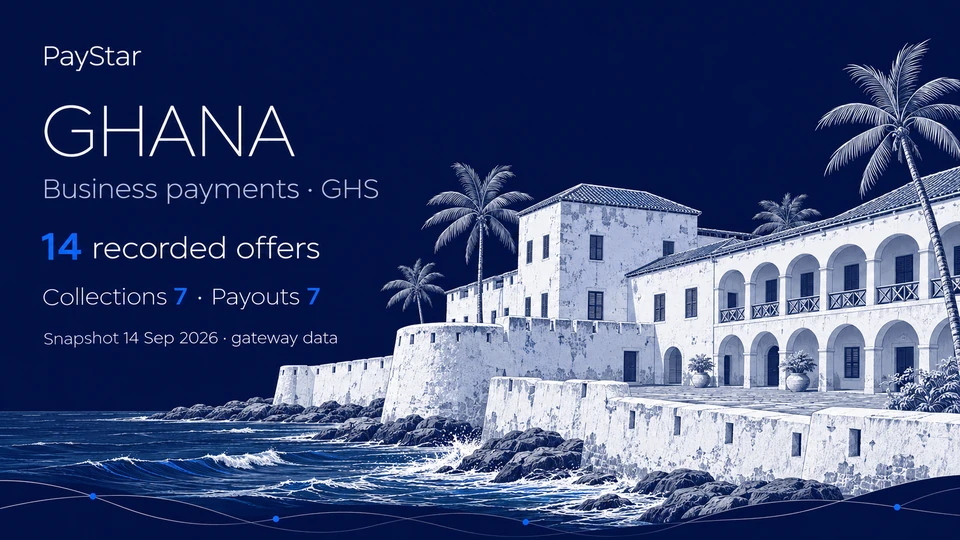
PayStar's 14 September 2026 snapshot contains 14 unique recorded payment offers associated only with Ghana: seven labelled Deposit and seven Withdrawal. All 14 have a GHS association. These are offer records, not 14 independent PSPs or verified live routes. Country, currency and method associations are recorded separately, so they do not prove every possible combination or current availability.
PayStar Discovery can help turn your Ghana requirements into a focused PSP shortlist. Share your company jurisdiction, business activity, payment points, collection and payout needs, expected volumes and settlement destination. You choose the PSP and contract with it directly; the PSP decides approval and is responsible for processing and settlement under that agreement.
Want information about these payment options for free? Just write to us. Contact Anastasia through PayStar Discovery. Free information concerns the payment options; it does not include integration, processing or all Discovery services. Availability and eligibility require separate confirmation.

PayStar’s role
PayStar provides information and technical services. PayStar is not a bank or PSP, does not arrange payment acceptance or settlement in its own name, does not receive or hold customer or merchant funds, and does not settle those funds. Payment services are provided by the selected provider under a direct agreement with the merchant. PayStar’s API, routing and monitoring operate within the agreed technical role.