
A customer has paid. Can you release the order, refund it if necessary, and use the proceeds for tomorrow’s payouts? Those are three different decisions. In Japan, a useful payment-provider comparison separates the checkout method, evidence of completed payment and the date when yen become available to the business.
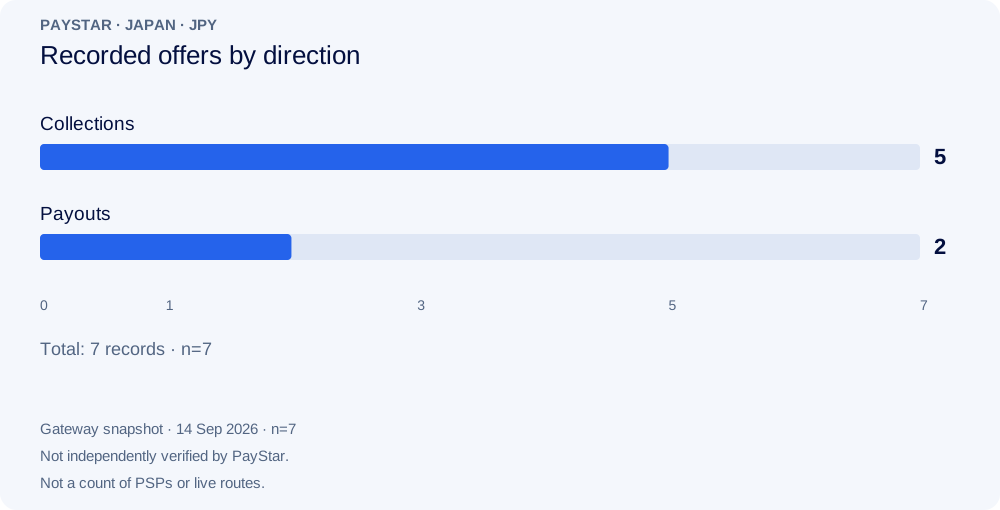
PayStar’s gateway-supplied snapshot dated 14 September 2026 contains 7 distinct offers linked only to Japan: 5 collection and 2 payout records. This is a compact historical research cohort, not seven payment methods, seven independent PSPs or seven verified live connections. Below we use that cohort to frame the questions worth answering before an integration.
What the seven records do—and do not—tell us
The count uses unique offer records, excluding repeat JOIN rows and multi-country coverage. Within the seven, currency links include JPY on 5 offers, EUR on 2 and USD on 2. These links overlap: 5 + 2 + 2 is not a count of nine offers. Country, currency and method relationships were exported independently, so they do not establish every possible method–currency–direction route.

JPY is the currency context of this article’s worked examples. We do not label all seven offers as JPY processing. Confirm the collection currency, provider balance currency, settlement currency and payout currency separately. A customer paying in yen does not by itself prove that the merchant receives yen without conversion.
The cohort is too small to disclose its actual private fee and settlement subgroups safely or present a meaningful comparable average. Consequently, no historical price mean, median, range or settlement distribution is published here. The following calculations use invented tariffs, not the rates of these seven records.
Start with the payment event you need
Pay-easy is a useful example of a reference-based payment journey. Its official guide describes payment using internet banking or supported financial-institution ATMs. It explicitly excludes convenience-store counters and convenience-store ATMs. A merchant should therefore distinguish this journey from a separate konbini proposition rather than place both behind an ambiguous “cash payment” label. Pay-easy official guide.
A QR display is not completed revenue. PayPay’s official Dynamic QR documentation distinguishes creation of a payment from completion; for the pre-authorization flow, authorization and later capture are also separate. The supported capabilities depend on onboarding and the contract. These are examples of local product behaviour, not evidence that the unnamed providers in our cohort support PayPay. PayPay OPA documentation.
Domestic bank movement is a different layer again. Zengin describes its system as relaying domestic credit transfers and clearing between participating financial institutions. That fact does not establish a merchant’s cross-border settlement arrangement or the time its provider releases funds. Zengin System.
Turn these distinctions into acceptance questions: which event permits fulfilment, how is an expired payment request handled, what is the refund path, and which reference links the provider’s report to your order?
Compare a fixed fee on your actual ticket size
Consider two purely hypothetical collection tariffs in JPY: A = 2%; B = 1.5% + JPY 30. We assume one successful payment per order, the same charging base and no rounding difference. The examples exclude taxes, FX, refunds, minimum charges and other costs.
At a JPY 1,000 payment, A costs JPY 20 and B costs JPY 45. At JPY 6,000 both cost JPY 120. At JPY 10,000 A costs JPY 200 and B costs JPY 180. The crossover is 30 ÷ (0.02 − 0.015) = JPY 6,000.

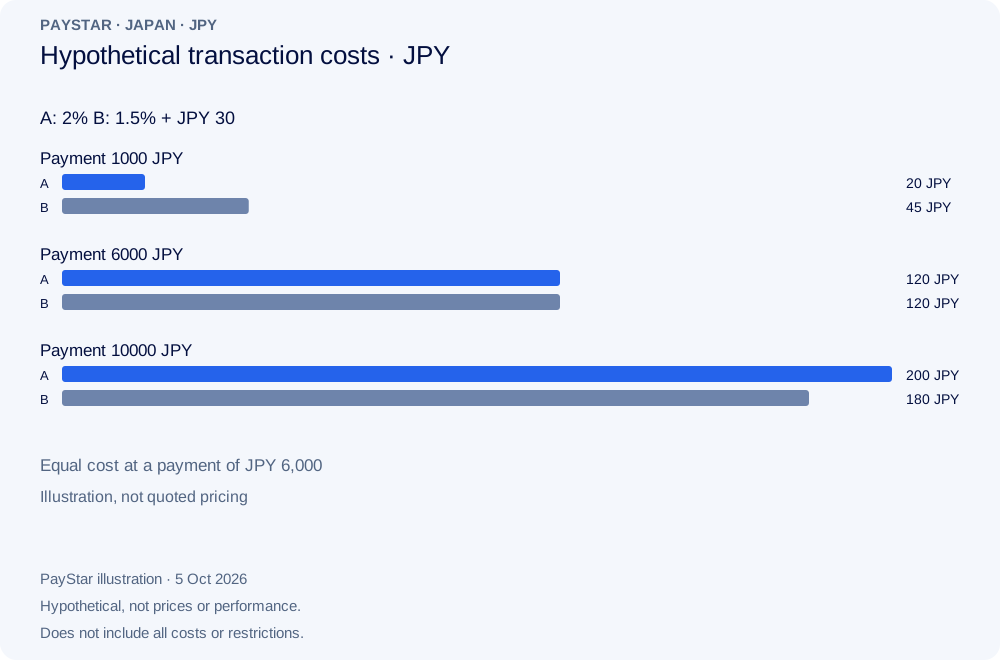
A lower percentage does not necessarily produce a lower bill on small orders. Apply the candidate’s actual quotation to your ticket distribution, including cancellations and repeat attempts. Confirm whether a fixed charge applies to an attempt, authorization, successful capture or payout. Test rounding at the transaction level rather than assuming it happens after monthly aggregation.
For payouts, request a separate quote: amount sent, amount received, transfer charge, failed-transfer charge and return charge. A collection quotation is not a payout quotation, even when the two appear under one provider account.
Available yen are more useful than a fast status
A “completed” payment and spendable settlement proceeds serve different purposes. Ask for a calendar example covering a weekday, a weekend and a local holiday. It should identify the cutoff, provider release date, bank credit date, reserves and the balance that can actually fund payouts. T+0 or D+0 in a historical offer is a recorded term, not a measured guarantee.
Here is a fictional funding example, entirely separate from the offer data. Gross receipts are JPY 1,000,000. Deduct JPY 20,000 in fees, JPY 50,000 held in reserve and JPY 200,000 not yet released. Those deductions are distinct and non-overlapping in the example. Available funds are JPY 730,000. If JPY 800,000 in payouts falls due, the funding gap is JPY 70,000.

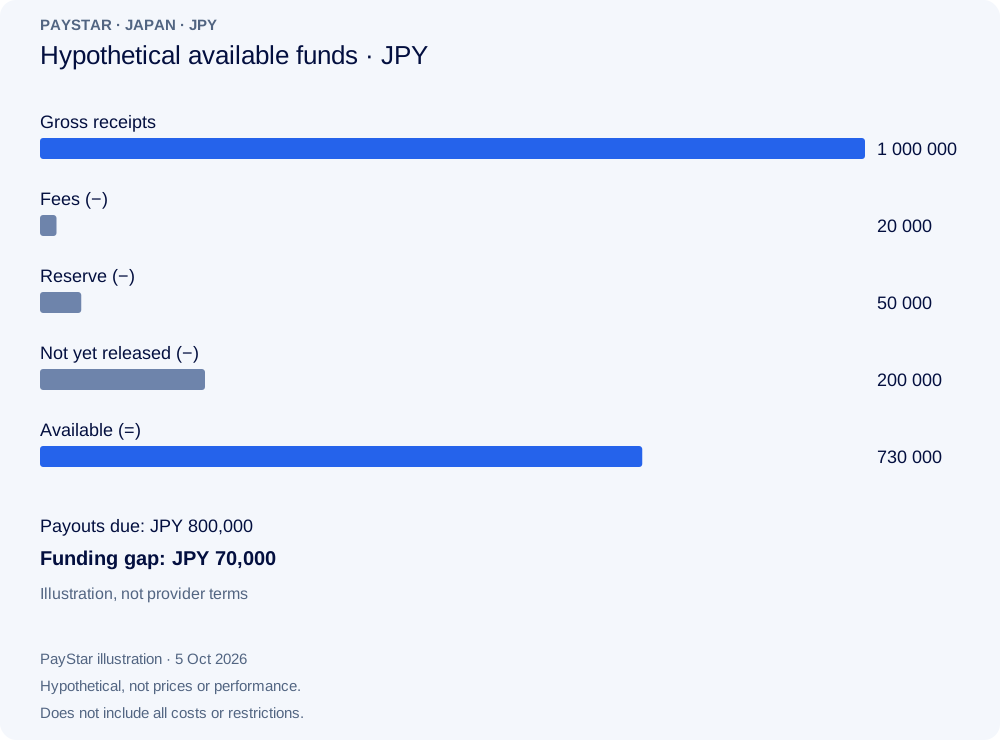
The example deliberately excludes opening cash, FX and additional bank costs. Its purpose is to expose timing, not estimate a Japanese market average. A candidate should explain whether payouts require prefunding, which balance pays fees and whether released funds can be reused automatically.
Measure completed orders and unresolved exceptions
This dataset does not contain one comparable, measured conversion sample, so we publish no average conversion rate. Nor can a product’s presence in a list establish that your customers can complete a particular checkout.
Before rollout, define your own denominator and record the stages separately: payment request created, customer started, authorization where relevant, completed payment, fulfilled order, refund and final reconciliation. Link repeated attempts to the same order so retries do not inflate the success count.
Test an expired request followed by late confirmation, a delayed callback, an uncertain timeout and a refund after fulfilment. A timeout should trigger status investigation under the provider’s documented process, not an uncontrolled duplicate charge or payout. Preserve the original provider reference alongside the normalized status.
A practical comparison is whether your operations team can answer “what happened to this order?” from consistent evidence. Request sample transaction and settlement reports, including timezone, gross amount, every deduction and the bank or provider reference used to close an exception.
Confirm the entity, contract and permitted use
Start with the legal entity named in the quotation and agreement. Japan’s Financial Services Agency publishes separate registers for different categories of financial institution, including fund-transfer service providers. Check the category relevant to the actual service and use the exact contracting name. Registry presence is one diligence input, not blanket approval for a merchant or route. FSA institution registers.
Ask the candidate to confirm eligibility for your incorporation country, product, customer locations, settlement destination and proposed flow. Request the permitted currencies, transaction and period limits, beneficiary information, refund rules and documentation requirements. Where a foreign merchant or cross-border flow is involved, obtain a specific answer for that structure rather than infer permission from a domestic payment-network description.
Keep the signed commercial schedule and operating procedure together. A provider’s technical documentation shows how a capability can work; only the applicable agreement and approved setup establish what your business may use. This article is editorial research, not a legal opinion or an approval of any specific provider.
PayStar’s role
PayStar provides information and agreed technical services. It is not a bank or PSP, does not arrange payment acceptance or settlement in its own name, does not receive or hold customer or merchant funds, and does not settle those funds.
The merchant selects the payment provider and contracts directly with it. That provider supplies the payment services, processing and settlement under its agreement with the merchant. PayStar’s API, routing and operational controls remain within the agreed technical role.
PayStar Discovery helps structure a shortlist and the questions behind it. Direct Connect addresses the agreed technical connection; Core supports routing and payment operations. Known, qualified, integrated and active are different states. None of them is inferred from a historical offer count, and no approval, conversion or settlement outcome is guaranteed.
Get details on payment gateways in Japan
Ask Anastasia for free information about payment options: methods and eligibility; fees, limits and currencies; settlement timing and documentation. Availability and terms need separate confirmation for your business.
Write to Anastasia on Telegram or email Anastasia@PayStar.uk. Free information does not mean free integration, processing or all Discovery services.
About the data and this review
Commercial snapshot: 14 September 2026. Official local sources reviewed: 14 October 2026. Gateway statements have not been independently verified; conditions can change weekly or more frequently. Internal aggregation checks establish counts, not the truth of a commercial claim.
The seven records are Japan-only historical offers after deduplication, with independent and potentially overlapping currency/method links. Actual small-cohort financial conditions are withheld. All tariff and funding examples above are explicitly fictional. No market share, active-provider count, measured speed or conversion statistic is claimed.
The cover is an editorial AI illustration, not a verified documentary view. The media library and downloadable RU/EN assets include separate chart context and two Telegram illustration styles. Preparing these assets does not authorize publication.