
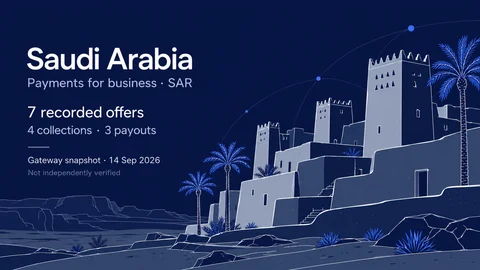
A successful checkout does not tell your finance team when it can pay a supplier. For a business entering Saudi Arabia, the useful comparison is the complete chain: which payment methods a provider can enable for your business, what each order costs, when SAR becomes available, and how an outgoing transfer is confirmed.
We reviewed 7 historical offer records linked only to Saudi Arabia: 4 for collections and 3 for payouts, in a gateway-supplied snapshot dated 14 September 2026. That gives a starting point for a provider brief, not seven independently verified providers or active connections. Below, we use the records to define the scope and clearly invented examples to explain the economics.
1. Seven offers define a research scope, not a ready-made route
The seven country-only records all have an independent SAR currency association. Another 74 records link Saudi Arabia alongside other countries; we exclude them from the headline cohort. Their broad coverage does not establish a local payment route.
A record can have several independent country, currency and method links. Those links do not establish every possible combination. Neither the catalogue status nor a SAR label proves that a particular business can use mada, an instant transfer, a recurring charge or a payout today.
With only four collection records and three payout records, we do not publish their individual commercial terms, fee averages or settlement distribution. We also lack a comparable transaction-level denominator and observation period for a conversion average. The examples below are invented; they are not quotations or measured performance. Current written terms and eligibility need separate confirmation, and conditions can change weekly or more often.

2. Ask which payment journey the provider actually supports
For online collections, ask about the exact mada checkout capabilities. SAMA's 7 July 2025 announcement describes a new e-commerce interface connecting national mada infrastructure with global networks and supporting card tokenization. It does not establish which features a particular provider offers to your company. SAMA: e-commerce payments interface.
Turn that into a practical acceptance test: supported card types, authentication, authorization versus capture, payment-status evidence, and refund handling. If you want saved-card or repeat-payment functionality, ask for its permitted use, customer consent requirements and the specific contract/API flow. Tokenization alone is not proof that every recurring-payment model is available.
For outgoing SAR, distinguish sarie instant payments from card acquiring and merchant settlement. SAMA describes sarie as a domestic low-value interbank transfer system operating around the clock, with beneficiary-name and corporate-account verification capabilities. Its system description is not a promise about PSP settlement or your payout API. SAMA: sarie.
Ask the candidate which bank channel it uses, the applicable business limits, account requirements, verification response, and the point at which a transfer is final. A bank's instant rail cannot release money that remains subject to a provider's reserve or settlement schedule.
3. Compare the cost at your order values
Illustrative tariffs, invented for this article: A charges 2% + SAR 0.50 per successful payment; B charges 2.8% with no fixed component. Neither tariff comes from the private records.
At a SAR 50 order, A costs SAR 1.50 and B costs SAR 1.40. At SAR 250, the costs are SAR 5.50 and SAR 7.00. At SAR 1,000, they are SAR 20.50 and SAR 28.00. The mathematical break-even order value is SAR 62.50: 0.02 × 62.50 + 0.50 = 0.028 × 62.50 = 1.75.
This example isolates the quoted percentage and fixed components. It excludes taxes, FX, minimum monthly charges, refunds, disputes, reserves and payout fees. It therefore compares these two fictional components, not the total cost of doing business.
For a real request, send an order-value distribution rather than only a monthly volume. Ask whether the fixed component applies to attempted or successful operations, whether collection fees are retained after refunds, and which separate costs appear in the settlement statement.

4. A mada approval and available bank cash are different events
Consider this fictional SAR reconciliation example, separate from tariffs A and B. Customers have paid SAR 10,000. Contractual deductions in the example are SAR 250 in fees and SAR 1,000 held in reserve. The remaining SAR 8,750 is scheduled for settlement; that is still not a bank-balance confirmation.
If the bank has credited SAR 6,500, SAR 2,250 of the scheduled amount remains to be reconciled or credited. The reserve is tracked separately. Do not count the full SAR 10,000—or even the scheduled SAR 8,750—as cash available for today's supplier payment.
The example assumes no other opening balances, deductions, taxes, refunds or FX movements. It is a ledger illustration, not a measured delay, an actual reserve requirement, revenue or profit. Releasing the hypothetical reserve later would be a separate event.
Agree on the report that joins the customer payment, provider transaction, settlement batch, deductions and bank reference. Ask how weekends, cut-off times, bank-account currency and reserve release affect your own contract. A T+0 label in a catalogue is not a measured bank-credit time.

5. Verify the beneficiary and reconcile the outcome
A payout needs two controls: the right destination before submission and the right money movement afterwards. For the sarie capabilities described by SAMA, ask your provider what beneficiary/account verification it exposes and how a mismatch should be handled. Do not assume a general system capability is present in every API or contract.
Keep the business obligation, destination account, verification result, submitted instruction and bank/provider references connected. A timeout is an unknown outcome until reconciled; blindly creating a second instruction can create a duplicate payment. Ask which identifier prevents duplicates, which statuses are final, and which report resolves a missing callback.
For a refund, first confirm whether it must follow the original payment method and how retained fees are reported. A separate bank payout is a different operation; do not assume it substitutes for a card refund or clears the original transaction.
Useful pilot evidence includes an ordinary payment, a failed payment, a refund, an account mismatch and a delayed final response. Agree which examples the provider can safely demonstrate. Measure your own results using a defined period and denominator; this catalogue offers no conversion benchmark.
6. Check the contracting entity and service scope
SAMA's implementing regulations establish the payment-services framework and list acquiring among the relevant payment services. Check the exact contracting entity, authorized activity and relevant service scope against current official information and the candidate's documents. A familiar brand name or a technical connection is not that verification. SAMA: implementing regulations, SAMA: licensed entities.
Before launch, provide your business model, ownership, establishment jurisdiction, customer geography, expected SAR flows and requested methods. Obtain written confirmation of merchant eligibility, settlement account, cross-border elements if any, prohibited activities and required documents. This article does not approve a nonresident business, a regulated activity or a particular route.
Local-source research was rechecked on 14 October 2026; the commercial snapshot remains 14 September 2026. Legal, compliance and tax decisions depend on the parties and operating model. Resolve those questions with the relevant qualified advisers and provider before integration.
7. PayStar's role
PayStar provides information and agreed technical services. It is not a bank or payment service provider, does not arrange payment acceptance or settlement in its own name, does not receive or hold customers' or merchants' funds, and does not settle those funds.
Your business chooses the PSP and contracts with it directly. The selected provider performs the payment services under that direct agreement. PayStar's API, routing and operational controls work within the separately agreed technical role; they do not replace the provider's eligibility decision, authorization or settlement obligations.
PayStar Discovery helps turn your market and operating requirements into a provider shortlist and questions to resolve. PayStar Direct Connect supplies the agreed integration layer; PayStar Core supports operating controls for connected routes. No product promises provider availability, approval or improved conversion.
8. Get details on payment gateways in Saudi Arabia
Send Anastasia your business model, establishment country, expected monthly SAR volume, order values, collection/payout needs and preferred methods. Ask for information on methods, fees and limits, settlement timing and currency, and product/document requirements.
The information is free. This does not make processing, integration or all Discovery services free. Availability, merchant eligibility and current terms are confirmed separately. Write to Anastasia on Telegram or email Anastasia.
9. Data and media notes
This article uses deduplicated offer records, not SQL JOIN rows. Historical gateway-supplied commercial statements have not been independently verified. Seven refers only to offers linked exclusively to Saudi Arabia in the 14 September 2026 snapshot; 4 collections plus 3 payouts equals 7. SAR is an independent currency association.
No provider identity, private contact, internal identifier, individual fee or settlement term is disclosed. Fictional calculations are marked beside their assumptions. Sources support only their stated local context and do not prove PayStar connectivity.
The illustrations are editorial AI interpretations of Najdi architecture inspired by Diriyah, not verified documentary views. Open the media library for RU/EN article covers, link-preview images, navy/bright Telegram graphics, chart downloads and article texts.