
When comparing payment providers in Singapore, map the money before comparing the checkout. Which legal entity receives it? Which account funds supplier payments? What happens to unpaid invoices when the business changes banks? PayNow makes the payment address convenient, but your operating model still needs clear answers to those questions.
This matters for businesses with several brands, departments or subsidiaries. A shared customer experience can conceal different account owners and balances. A useful PSP shortlist should reflect those distinctions from the start.
Start with the entity and its account
The Association of Banks in Singapore describes PayNow Corporate as linking an entity's Singapore-issued Unique Entity Number, or UEN, to its Singapore bank or e-wallet account for SGD transfers. Registration is through a participating institution. This establishes the local account relationship to qualify; it does not establish that every overseas merchant can accept PayNow. ABS: PayNow Corporate.
Multiple accounts need deliberate registration. Maybank explains that adding a three-character suffix to a UEN creates additional PayNow IDs, each linked to an account at the same or another bank. Maybank: PayNow Corporate.
There are ownership boundaries. DBS states that one proxy links to one account and that a company's UEN cannot link to another entity's account, including a subsidiary's. Treat those as documented bank conditions to confirm in your proposed arrangement. A suffix should not be assumed to solve collections across different legal entities. DBS: registration FAQs.
Give each candidate a simple account map: contracting company, UEN, proposed suffix, account owner, receiving account and business purpose. Ask it to explain any difference between that map and the service it proposes.
The payment address and the invoice reference have different jobs
A PayNow proxy determines the receiving registration. It does not, by itself, explain which invoice a receipt clears.
DBS's documentation illustrates why statement samples matter: incoming records contain a customer reference and payer details, but do not contain the PayNow proxy details. The customer reference may be entered by the payer or embedded in the QR. This is a specific reporting example, not a specification for every PSP. DBS: receive-with-PayNow FAQs.
Before integration, request a sample receipt with its statement entry and any machine-readable notification. Verify that your accounting system can preserve the invoice reference, destination account and final payment evidence. Include an incomplete-reference case in the demonstration: who investigates it, and what prevents the wrong invoice being closed?

Test usable balances with a realistic example
Consider a hypothetical Singapore company with two divisions and two registered receiving accounts. Consulting receives SGD 1,200; training receives SGD 800. Total receipts are SGD 2,000. The company must make a SGD 1,500 supplier payment from the consulting account.
Assuming no other balance, fees or holds, that account is SGD 300 short even though the company has enough money across both accounts. A suffix separates where receipts arrive; it does not establish an automatic transfer between balances.
Ask the provider to demonstrate the complete sequence:
| Step | What the finance team needs to establish |
|---|---|
| Receive | Which account receives each division's payment and when the funds are usable. |
| Fund | How the SGD 300 shortfall is covered, who authorises it and when it becomes available. |
| Pay | Which service sends the SGD 1,500 and how the supplier's details are checked. |
| Reconcile | How the two receipts, funding transfer, supplier payment and any fees remain distinguishable. |
These are requirements for a proposed setup, not capabilities inferred from PayNow registration. Request separate terms for collections, business payouts, refunds and any PSP settlement balance.

SGQR simplifies presentation; confirm the accepted options
MAS describes SGQR as one label combining multiple payment schemes. Its guidance says customers can use a payment option when the merchant supports it. A single label therefore needs an explicit acceptance list in your provider comparison. Confirm the supported customer apps, commercial agreement and reporting for each required option. MAS: Singapore Quick Response Code.
Also check the name customers see. ABS's April 2026 notice explains that businesses receiving through a UEN display their registered account name; corporate names were unchanged by the June 2026 removal of retail nicknames. If a trading brand differs from the account name, make the payment instructions clear and test the customer journey. ABS: corporate-name FAQ.
Include a bank change in the operating plan
Receivables can outlive an account arrangement. DBS says closing a linked account automatically deregisters its PayNow proxy. Before changing accounts, agree how outstanding invoices, stored QR codes and customer payment instructions will be handled. Ask the receiving institutions what must be changed and verify the new destination before issuing updated instructions. Do not assume an old QR will remain usable. DBS: account-closure FAQ.
For SGD payouts, separately confirm permitted recipients, funding requirements, approval controls, limits and unsuccessful-payment reporting. Domestic collection support does not establish a foreign-currency conversion or overseas settlement service; qualify those requirements explicitly.
What PayStar's recorded offers contribute
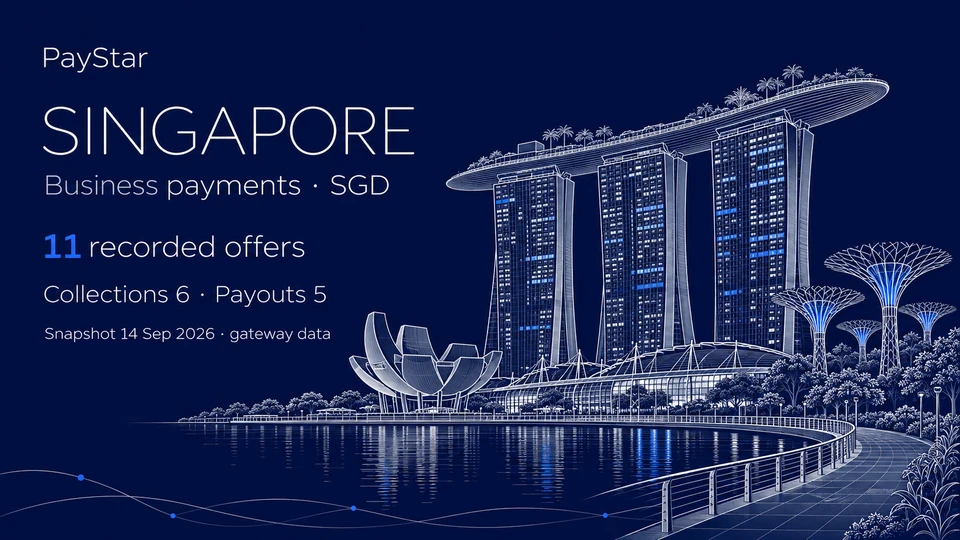
The 14 September 2026 snapshot contains 11 unique recorded payment offers associated only with Singapore: six labelled Deposit and five Withdrawal. All 11 have an SGD association. These are recorded offers, not counts of independent PSPs or active connections. Separate country, currency and method links do not prove every combination works.
PayStar Discovery can help structure a shortlist around your company, account model, payment directions and expected volumes. You choose the PSP and contract with it directly; the PSP decides approval and handles processing and settlement under that agreement.
Want information about these payment options for free? Just write to us. Contact Anastasia through PayStar Discovery with your entity and account requirements. Current availability, eligibility and commercial terms need confirmation. Free information does not mean free integration, processing or all subsequent Discovery work.

PayStar’s role
PayStar provides information and technical services. PayStar is not a bank or PSP, does not arrange payment acceptance or settlement in its own name, does not receive or hold customer or merchant funds, and does not settle those funds. Payment services are provided by the selected provider under a direct agreement with the merchant. PayStar’s API, routing and monitoring operate within the agreed technical role.