
A customer scanning a merchant QR, paying from a linked bank account and receiving a business payout are three different flows. In Sri Lanka, putting them into one line called “local payments” can hide the fee, limit and confirmation that determine whether an order can proceed.
We reviewed 7 historical payment offers linked only to Sri Lanka in the gateway-supplied PayStar snapshot of 14 September 2026: 3 collection offers and 4 payout offers. The practical question is how to turn a list of possibilities into a payment operation with a known cost, a reliable result and usable LKR.
What the seven offers can tell a business
All seven records have LKR currency links. They are seven unique offers, not seven independent providers, payment methods, integrations or currently available routes. Country, currency and method links were stored independently, so their appearance together does not establish a working commercial combination. The snapshot is historical and commercial statements from gateways have not been independently verified by PayStar; conditions can change weekly or more often.

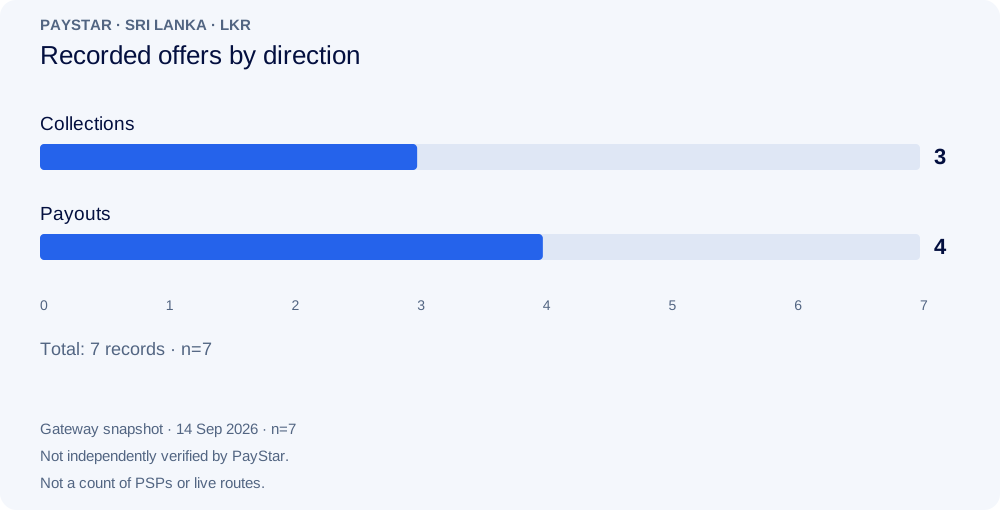
We publish the size and direction of this small cohort, but withhold actual fee and settlement statistics that could expose individual nonpublic terms. No weighted market average, conversion benchmark or provider ranking can be inferred. The catalogue helps frame the questions; a provider must confirm eligibility, scope and current terms for your business.
Merchant QR, JustPay and CEFTS need different checks
LANKAQR merchant acceptance. LankaPay describes a scan-and-pay business flow and directs merchants to participating financial institutions for a merchant QR. Confirm how each order receives its reference, amount and final payment evidence. A QR image and a customer's screenshot do not by themselves reconcile the order. The network's merchant information does not establish availability through any catalogue offer. LankaPay: LANKAQR for business.
JustPay checkout. LankaPay describes account-based customer payments and lists both mobile and web applications. Ask which channel is actually offered, how the customer authorises it and what happens after a timeout. A web checkout and a mobile-app flow should not be treated as interchangeable integration deliverables. LankaPay: JustPay for business.
CEFTS business transfers. LankaPay identifies supplier, employee and invoice payments as business use cases. The useful operating questions are the beneficiary account format, payment reference, result status and retry procedure. Its published account-format list varies by institution: validate against the receiving institution rather than applying one universal account length. LankaPay: CEFTS for business.
Ask each candidate to demonstrate your specific operation. A successful customer collection does not demonstrate a supported refund or a business payout to the same person.
Price the basket, not just the percentage
A useful quote names the operation, payer and merchant fees separately; transaction size; fixed charges; refund treatment; and any account or integration costs. For JustPay, the CBSL circular effective 2 February 2026 specifies a LKR 150,000 maximum transaction value and tiered maximum customer and merchant fees. For a transaction above LKR 8,000 within that limit, it lists customer and merchant caps of LKR 20 and LKR 40, respectively. These are different fee categories, not two fees automatically payable by the merchant. Confirm the precise applicable service before comparing a quote. CBSL: Circular 01/2026.
The following is a fictional generic processing-contract example, not a JustPay or LANKAQR tariff and not a quotation from our dataset. Contract A charges 2%; contract B charges 1.5% plus LKR 50. At a LKR 2,000 payment, costs are LKR 40 and LKR 80. At LKR 10,000, both cost LKR 200; at LKR 20,000, they cost LKR 400 and LKR 350. The lower percentage becomes cheaper only above the LKR 10,000 break-even point in this simplified model.

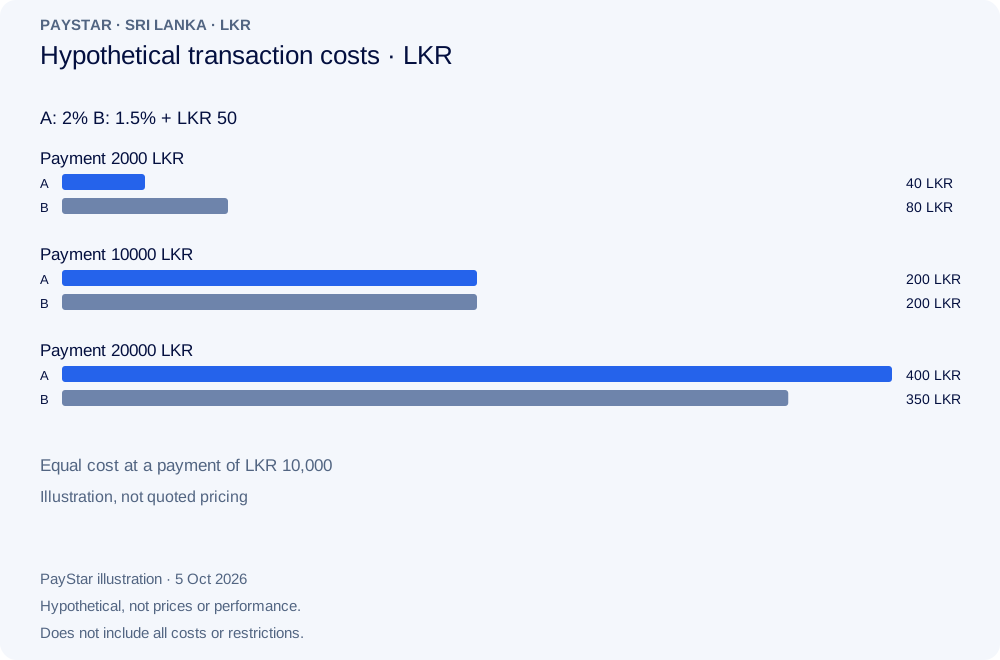
Use your actual distribution of successful payments, not just its average ticket. Add relevant taxes, conversion, minimum fees, refund charges and other contract items separately. The example excludes these and does not suggest that a scheme fee cap can be bypassed through extra charges.
A fast transfer still needs available LKR
A network transfer speed is not the same as a PSP's release of merchant funds. Obtain the settlement account, settlement currency, cut-off and non-business-day policy, reserves, withdrawal rules and evidence that funds can be used for the next obligation. A recorded T+0 label is a contractual statement in a historical record, not measured performance or a guarantee.
Consider a fictional funding example: LKR 1,000,000 of receipts minus LKR 20,000 of fees, LKR 50,000 held as a hypothetical reserve and LKR 200,000 not yet released leaves LKR 730,000 usable. These three deductions are separate, non-overlapping amounts. If payouts of LKR 800,000 are due, the funding gap is LKR 70,000. These are invented planning amounts; neither the reserve nor the delay is a claim about Sri Lankan providers.

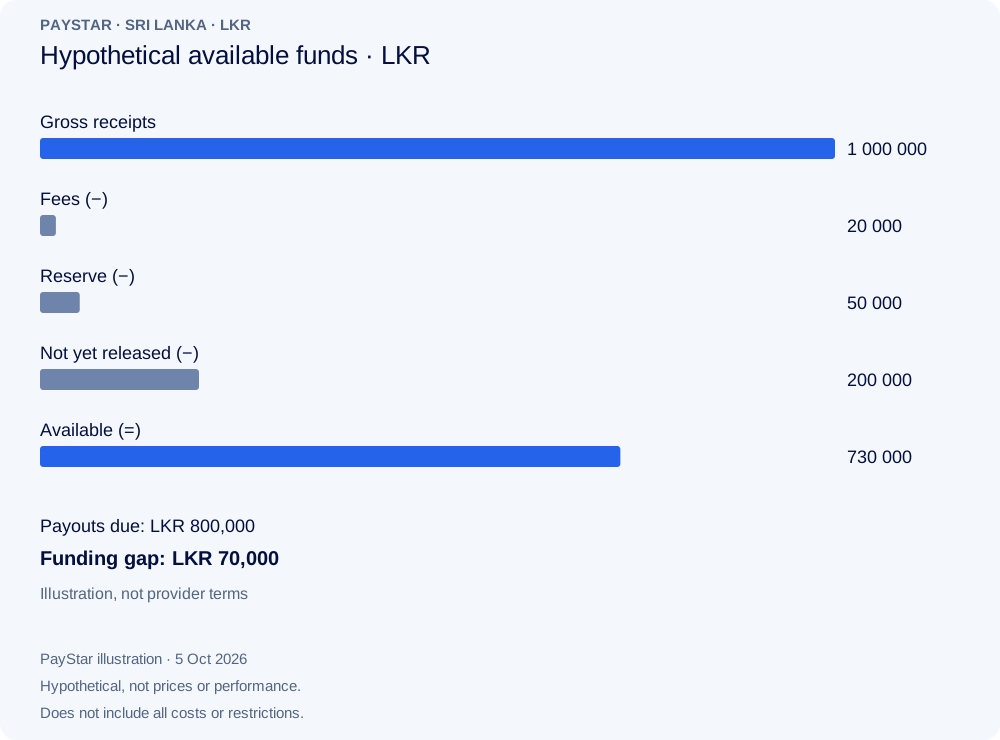
Reconcile usable funds against obligations by deadline. Separately agree who bears a return or reversal after money has already been used. Receiving LKR domestically also does not establish a permitted or available cross-border remittance or foreign-currency settlement route.
Measure the result before retrying
There is no common, measured conversion dataset in this snapshot. Ask for an evaluation based on your own attempted orders and define its denominator: initiated checkout, authorised payment, confirmed collection or completed payout. Do not compare unlike definitions.
Before launch, test an ordinary success, an abandoned authorisation, delayed confirmation, duplicate notification, a timeout with an unknown result, and a refund or return where that operation is supported. Keep the merchant order, provider operation reference and bank evidence linked. For an unknown payout result, query or investigate the original operation before submitting another transfer; a second submission can create a second payment.
The useful output of testing is an agreed decision for each state: fulfil, wait, investigate, refund or retry under the provider's documented rules. A network's existence does not supply that operating procedure.
Keep the 2026 rules attached to the right operation
CBSL's 2026 LANKAQR instruments address local-currency payments and peer-to-peer transfers. A P2P specification should not be substituted for merchant acceptance requirements. Ask the acquiring institution to identify the applicable mode, current transaction limits, fees and effective rules in writing. CBSL: Circular 02/2026, Addendum 1, 17 June 2026.
LankaPay describes CEFTS business transfers of up to LKR 5 million. CBSL's channel-specific maximum customer fee of LKR 25 applies to internet banking, mobile banking and the respective CEFTS member's ATMs, effective 15 February 2025. This is not a universal quotation for every payout API or additional service. Provider limits may be lower; confirm the channel and all applicable charges. LankaPay: CEFTS, CBSL: policy measures.
Before contracting, confirm the provider's authorisation and actual service, merchant registration and settlement account requirements, business activity, beneficial owners, expected volumes and any cross-border element. Applicable currency, AML and business restrictions require review for the actual parties and purpose; this article does not approve a company or route.
PayStar's role
PayStar provides information and agreed technical services. It is not a bank or PSP, does not arrange payment acceptance or settlement in its own name, does not receive or hold buyer or merchant funds, and does not settle those funds. The merchant selects the provider and enters into a direct merchant–PSP agreement; the selected provider performs the payment services under that agreement.
PayStar Discovery helps structure the comparison and qualification questions. Where separately agreed, Direct Connect provides the technical API layer and Core supports routing, monitoring and reconciliation within PayStar's technical role. These services do not guarantee provider availability, eligibility, approval, conversion or settlement.
Get details on payment gateways in Sri Lanka
Ask Anastasia for free information about methods, fees and limits, settlement timing and currency, and product and document requirements. Availability and eligibility need separate confirmation with the selected provider. Free information does not mean free processing, integration or every Discovery service.
Write to Anastasia on Telegram or email Anastasia@PayStar.uk. The next useful result is a comparable set of answers for your collection or payout flow.
Data and reading notes
Historical catalogue snapshot: 14 September 2026. Source review updated 14 October 2026 using operator pages, indexed original CBSL text and official CBSL publications. Several original circular PDFs were inaccessible; unverified P2P limits and exception details are omitted. Seven unique Sri Lanka-only offer records; LKR links do not prove every method/operation combination. Actual small-cohort commercial terms and provider identities are withheld. The two financial examples are explicitly fictional and exclude some costs and restrictions. Official scheme rules are separate from catalogue claims and from an individual provider's approved capabilities. Cover art is an editorial AI interpretation of Sigiriya, not a verified documentary view.