
An instant payment is useful only if the business can match it to an order, understand its cost and use the proceeds when needed. In the UAE, Aani and Jaywan raise different integration questions. A good shortlist connects the customer experience with the merchant’s cash flow.
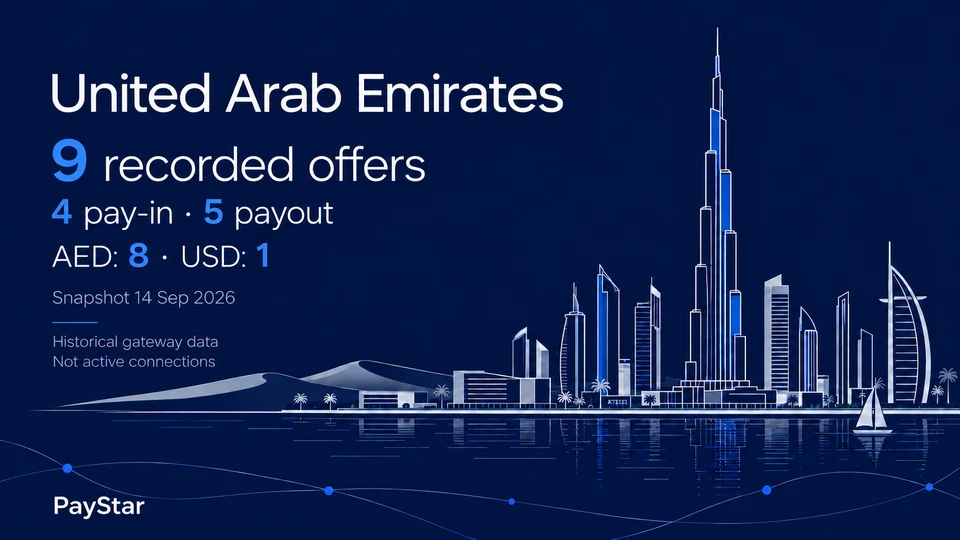
We reviewed 9 UAE-only offer records in PayStar’s gateway-supplied snapshot of 14 September 2026: 4 pay-in and 5 payout records. This is a dated starting point for comparison, not a list of nine payment methods, nine providers or currently available integrations.
What the nine records actually tell us
Eight records are linked to AED and one to USD. Those currency links do not establish the currency in which a merchant will receive usable funds. Collection currency, the currency used to fund payouts, and final settlement currency belong in separate fields of a proposal.
The source records name only the UAE in their country links. That is narrower than international coverage, but still does not establish eligibility for a particular merchant, a cross-border service or support for Aani or Jaywan. Independent country, currency and method links cannot prove every possible route combination.

We do not publish fee averages or a settlement-speed distribution for this small sample. The comparable fee subsets are too small for a useful anonymous benchmark, and settlement labels are unverified commercial statements. The original information came from gateways; our checks validate the aggregation, not the underlying claims. Terms can change weekly or more often. Ask for a dated, business-specific proposal before budgeting.
Aani: connect the request to the confirmed payment
Aani is operated by Al Etihad Payments. Its corporate guidance describes transfers through participating financial institutions or PSPs using references such as a phone number or email, together with QR payments and Request to Pay. Access and onboarding are arranged with the institution serving the business. AEP’s corporate guidance.
For an online business, the practical test is the full order journey. Request an example covering an unpaid request, a confirmed payment, a timeout and a repeated notification. Establish which reference matches the payment to the order and which authoritative status allows fulfilment. A request screen or a customer’s screenshot alone should not trigger delivery. These are recommended integration tests, not claims about a particular Aani API.
AEP’s merchant FAQ directs businesses to their financial institution or PSP for availability and charges. There is no universal merchant tariff in that guidance. Ask which Aani functions your specific entity can use today, in which channel, and under which contract. Do not treat a network description or a planned feature as proof of your own production access. AEP’s merchant guidance.
Jaywan: confirm the acceptance channel
Jaywan is the UAE’s domestic card scheme. AEP describes its debit and prepaid focus, while the central bank’s launch material distinguishes mono-badged and co-badged cards. This makes card type and acceptance channel relevant questions for a merchant. AEP on Jaywan · CBUAE’s scheme announcement.
Request written confirmation of the cards and channels your acquirer supports, including online acceptance where relevant. Then ask how authorisation, capture, refund and reconciliation appear in the integration and reports. Scheme recognition does not establish that a particular gateway is enabled, that all cards follow the same path, or that your total cost will be lower. Compare an actual proposal using your order mix.
A smaller percentage can cost more
Illustrative arithmetic only — these are invented tariffs, not UAE market prices or quotes from the snapshot. Suppose proposal A charges 2% + AED 1, and proposal B charges 1% + AED 4 per successful payment. On an AED 100 order, A costs AED 3 and B AED 5. On an AED 500 order, A costs AED 11 and B AED 9.

The two examples meet at an AED 300 order, where either fee is AED 7. The comparison changes with order size, even though B always has the lower percentage. Apply the calculation to the distribution of your orders, especially low-value purchases; an average ticket can conceal an expensive segment.
This simplified model excludes taxes, conversion, refunds, disputes, minimum charges, payout charges and settlement-transfer costs. It also assumes the same charging event and successful transaction count. Have the provider state whether a fee is charged on attempts, successes, refunds or another event. Add each applicable item to a single cost model without combining favourable terms from different offers.
Confirmed sales are not the payout budget
A second fictional example: a business records AED 20,000 of paid sales. For this example, it allocates AED 400 to fees, AED 1,000 to refunds and AED 2,000 to a reserve. The remaining usable amount is AED 16,600. If AED 18,000 of payouts must be funded at that point, the gap is AED 1,400.

None of these deductions or amounts describes a gateway in our sample. The point is to put the next obligation on the same timeline as usable funds. A payment confirmation, a gateway balance, a settlement instruction and a credit to the designated account can be different events. Ask the provider to define each event, its currency and its evidence.
Check whether collected revenue can fund payouts directly, when any reserve is released, and what happens on weekends or after a cut-off. If a proposal uses a same-day label, ask what starts the clock and where the funds must arrive. A historical label alone is neither an observed delivery time nor an assurance that tomorrow’s payout run is funded.
Measure the failure you want to fix
This export does not contain a common, measured conversion dataset. We therefore have no comparable average success rate to publish. For a pilot, define the denominator before comparing providers: unique orders, first attempts and all retries answer different questions.
Keep paid, declined, expired and unresolved outcomes separate. Measure the time to a reliable final status and the share of payments that match automatically to an order. For payouts, check beneficiary validation, duplicate protection, rejection reasons and reconciliation. These measures help distinguish checkout friction from a confirmation delay or an insufficient payout balance.
Eligibility comes before a live route
The CBUAE licensing page identifies regulated payment activities and provides an institution register. Verify the actual contracting entity and the permissions relevant to the proposed service; a brand name or technical connection is insufficient. The merchant’s own activity and documents also need an applicable assessment. CBUAE licensing and register.
A catalogue label for a token does not establish a lawful settlement arrangement. The CBUAE’s Payment Token Services Regulation separately limits token services and merchant acceptance. This article offers no token settlement route. Obtain an activity- and jurisdiction-specific assessment, including any applicable financial-free-zone framework, before considering one. CBUAE Payment Token Services Regulation.
Official sources were checked on 14 October 2026, separately from the commercial snapshot. Some AEP pages retain rollout language; availability must be checked with the serving institution. The token rulebook’s indexed official text was accessible, but its direct page could not be retrieved during the current review. Recheck the operative rules and relevant permissions before launch. PayStar supports lawful activity and appropriately authorised payment services; this guide is not approval of a business or route.
PayStar’s role
PayStar provides information and agreed technical services. PayStar is not a bank or PSP, does not organise payment acceptance or settlement in its own name, does not receive or hold customer or merchant funds, and does not settle those funds. Payment services are provided by the selected provider under a direct contract with the merchant. The provider is responsible for payment processing and settlement under that contract. PayStar’s API, routing and controls operate within the agreed technical role.
PayStar can help structure a shortlist and compare the conditions that matter for your business. Method support, fees, limits, acceptance and settlement require confirmation by the provider for the particular product and entity. A connection is not a guarantee of approval, availability or performance.
What to request from Anastasia
Ask for details on UAE payment gateways: methods, fees and limits; settlement timing and currency; product and document requirements. Bring the intended customer geography, order-size range and payout needs to the discussion so the comparison can focus on relevant terms. The information is free; payment processing and integration conditions are agreed separately.
Contact Anastasia on Telegram or email Anastasia.